01495 427946southwalesliquidscreed@gmail.com
Mon–Fri 7:30–17:30 · Sat 9–14
South Wales Liquid Screed
01495 427946Free Quote
UFH-optimised mixes · Pressure tested before pour

Underfloor Heating ScreedAcross South WalesOptimised For Output

Liquid screed laid over underfloor heating pipework, denser, void-free and thermally tuned so every watt your boiler produces ends up warming the room, not the foundation.

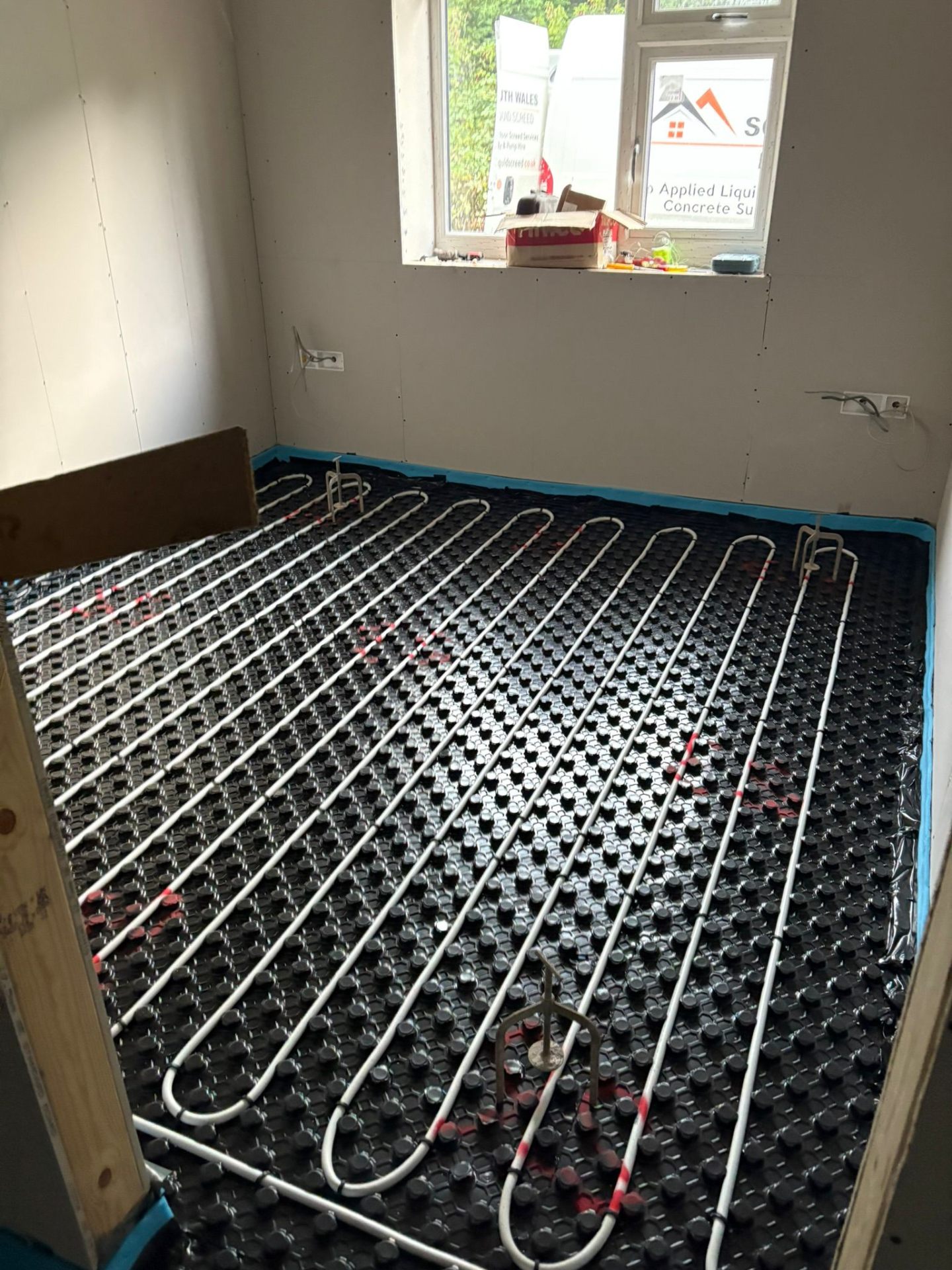
Underfloor heating PEX pipework clipped to dimpled insulation panels prior to screed
30%
Faster heat response
0
Hot-spots or cold patches
30+
Years of UFH pours
10yr
Manufacturer warranty
UFH Screed Explained

The Only Screed That Lets Your UFH Perform How It Was Designed

What it is

Underfloor heating screed is a liquid (flowing) screed pour engineered specifically for use over UFH pipework. Calcium sulphate or specialist cementitious slurry flows around every pipe, eliminating the air voids that wreck UFH performance with traditional sand-and-cement.

Who it's for

Anyone specifying wet underfloor heating in new-build, extension or refurbishment. Critical for homeowners paying for premium UFH systems, and for housebuilders selling 'low-running-cost homes' where the heating bill backs up the marketing.

When it's needed

Always. Sand-and-cement screed over UFH is a compromise, slower to respond, more energy wasted, hotter-set boiler, higher bills. Liquid screed over UFH is the design intent. If the system was specified to perform a certain way, this is the only screed that lets it.

Why a professional matters

UFH screed combines three skills: substrate prep, pipework pressure management, and screed pouring. Get any one wrong and the system underperforms for the building's life. Our crew has poured over UFH on hundreds of South Wales sites, from small extensions to multi-storey commercial.

The Cost Of Getting It Wrong

What Bad UFH Screed Costs The Homeowner

An expensive UFH system in a badly-screeded floor performs worse than a cheap radiator. Here's why.

What Goes Wrong

  • !

    Cold spots and stripes

    Sand-and-cement screed leaves voids around pipework. Voids don't conduct heat. The homeowner gets a striped floor, warm where the pipes are, cold between them, and a complaint they never escape.

  • !

    Slow heat response

    Thick, low-conductivity screed takes hours to reach temperature. The thermostat is permanently chasing the room, the boiler is permanently running, and the bill is permanently high.

  • !

    Pipework damage during pour

    Unrestrained pipes that lift during a careless pour can be displaced above the screed surface, leaks waiting to happen, weeks or years after the floor is finished.

Common Mistakes

  • ×

    Letting the screeder pressure-test

    Pipework should be tested by the UFH installer or competent crew before pour, with pressure held during the pour. Many cheap screeders skip both. We don't.

  • ×

    Using the wrong product over UFH

    Standard sand-and-cement is the wrong product over UFH. Specify liquid screed from the start, retrofitting later means lifting the entire floor.

  • ×

    Pouring without commissioning plan

    Liquid screed over UFH requires a controlled commissioning heat cycle starting at 21 days. Skip this and the floor finish goes down on a slab that hasn't been heat-cycled, risking later cracking and finish failure.

Our Process

From Enquiry To Handover

01

Quick Phone Quote

Call us with postcode, area and timing. We give you an indicative price on the spot, often within minutes.

02

Free Survey For Local Enquiries

For local jobs we visit, measure, and confirm specification for your underfloor heating screed at no charge. Charges may apply for surveys further afield, agreed up front.

03

Written Quote In 24 Hours

Written quotation in your inbox within one working day of the survey, confirming m² rate, mix design and a firm pour date. All quotes subject to site survey.

04

Pour & Finish

Our crew arrives on time with kit, pumps and labour. Continuous flow, level checks, and a clean handover at the end of shift.

05

Handover

Moisture testing on request and after-care guidance so the next trade can start with confidence.

Why It Matters

The Benefits, In Concrete

30% Faster Heat-Up

Dense, void-free screed conducts heat far better than sand-and-cement. Rooms reach temperature faster, the boiler cycles less, bills drop.

No Hot-Spots Or Cold Patches

Self-levelling slurry flows around every millimetre of pipework, even, predictable heat across the entire floor.

Lower Running Costs

Better thermal output means a lower boiler setpoint to achieve the same comfort. Lifetime savings dwarf the up-front cost difference.

System-Life Performance

Properly poured UFH screed performs identically in year 20 as in year 1.

Pressure Tested Through Pour

We pressure-test pipework before the pour and hold pressure during it. Any pour-time damage shows immediately, not when the finished floor is heated.

One Contractor For Prep, Pour & Commissioning Plan

We hand over with a written commissioning heat cycle so the UFH installer can start the floor on the right schedule.

Technical Detail

UFH Screed Specification, Methods & Commissioning

Pouring screed over UFH is a different job from pouring a plain slab. Here's what we do differently, and why.

Calcium sulphate for UFH, why it's the standard

Calcium sulphate (anhydrite) liquid screed has roughly twice the thermal conductivity of standard sand-and-cement. Combined with its self-levelling void-free flow, it's the European standard for UFH overpour. Lower thermal mass means faster room response, lower running setpoint, and meaningful savings over a 20-year boiler life.

Minimum cover and pour depth

30mm minimum cover above the highest point of pipework for floating screed over insulation. Total pour depth typically 50–65mm including pipework. We measure pipework set-out before the pour and check minimum cover at multiple points during the pour to guarantee compliance.

Pressure testing and pipe restraint

Pipework pressurised to 6 bar before pour. Pressure held during pour. Pipework clipped at maximum 300mm centres and at every turn. Penetrations restrained against floating. If a leak appears mid-pour, we know immediately and can isolate that loop before the screed sets around it.

Commissioning heat cycle

Liquid screed over UFH requires a controlled first-heat sequence starting at 21 days minimum. Begin at 25°C flow, raise by 5°C per day to maximum design flow, hold for 72 hours, then ramp back down. Floor finish goes down only after the full cycle completes. We hand this schedule to the UFH installer as a written document on completion.

Residential vs commercial UFH overpour

Residential UFH typically 70–200m² per plot, fast turnaround, focus on flatness for tile or LVT finish. Commercial UFH (offices, leisure, retail) typically 500m²+ per pour, with structural loading, joint detailing and trade integration. Our crew handles both, and we mobilise the right size of pump and wagon for each.

Recent Work

UFH Screed Pours On Site

Real photos from recent South Wales underfloor heating screed jobs, pump set-ups, pour days and finished floors.

View Full Gallery
Underfloor heating PEX pipework clipped to dimpled insulation panels
UFH circuits laid out across a kitchen extension floor
Wet underfloor heating pipework manifold connections on site
Underfloor heating loops set ready for screed cover
UFH dimpled board insulation with PEX clipped on 200mm centres
Underfloor heating pipework around door threshold reveal
FAQ

Underfloor Heating Screed Questions, Answered

Still unsure? Call 01495 427946

How much does UFH screed cost in South Wales?+

Typically £22–£30 per m² installed including liquid screed, edge insulation and pipework restraint, excluding the UFH pipework system itself. Quoted firm within 24 hours of survey.

What depth of screed do you pour over UFH?+

Total pour depth typically 50–65mm with a minimum 30mm cover above the highest pipe. We confirm exact depth on the survey based on insulation depth, pipework centres and floor finish requirements.

How long before I can switch on the heating?+

Minimum 21 days from pour before first commissioning heat cycle. Full cycle typically takes 7–10 days to complete safely. Floor finish then goes down after moisture testing.

Can I lay liquid screed over an existing UFH system?+

Yes, common in refurbishment. We assess existing pipework condition, pressure-test before pour, and confirm compatibility with the existing system.

Will liquid screed work with my UFH manufacturer?+

Yes, liquid screed is compatible with all major UFH systems (Nu-Heat, Polypipe, Uponor, Continal, JG Speedfit). We work to the manufacturer's commissioning schedule.

Is liquid screed better than sand-and-cement for UFH?+

Significantly. Roughly twice the thermal conductivity, no void formation around pipes, faster response and lower running costs over the system's life. Sand-and-cement is the wrong product over UFH.

How is UFH performance assured?+

We pressure-test pipework before the pour, hold pressure during it, and follow the manufacturer's commissioning schedule. UFH system performance is covered by the system manufacturer's warranty; a properly installed screed is the prerequisite for that warranty to deliver.

Can you co-ordinate with my UFH installer?+

Yes, we routinely co-ordinate with all major South Wales UFH installers. We handle the prep, the pressure-testing protocol, and the pour; they handle commissioning. One project, two trades, zero finger-pointing.

Next Step

Get A UFH Screed Quote Within 24 Hours

Tell us the postcode and the m². We give an indicative price on the call and firm it up in writing after a site survey.

Request Free Quote 01495 427946
  • 30+ years experience
  • Fully insured
  • Free site survey for local enquiries
  • Written quote within 24hrs
Related Services

Often Specified Alongside

Where We Pour

UFH Screed Across South Wales

From Blackwood, we pour daily in:

Call NowGet Free Quote